Wednesday, April 21, 2021

Disassembling Endo, part 1

Since it was recently Easter, I decided to revisit what's probably my favourite easter egg hunt / programming contest ever: ICFP 2007. It's a problem where you are given a description of a strange virtual machine together with a large and slightly damaged program for it, and have to modify it to make it produce the right output, with reward for the most minimal modifications. The original contest was 72 hours, but this time around I'm spending a lot more time on it because I really wanted to investigate all the intricacies and solve all the puzzles.

I'm going to make a walkthrough on this blog since I find it interesting to look back at the chain of clues to see just how much depth the problem authors put into it. At the time our team wrote a blog post which described how far we got, and it has links to a lot of similar writeups, but I'm not aware of a complete walkthough. The link above has a report from the authors that briefly describes a few of the puzzles, but not everything. Jochen Hoenicke also has a page listing a highly optimised solution which perfectly reproduces the target image, but it's not a walkthrough: without having tackled the problem yourself the explanation will not make much sense.

Like any walkthrough, this blog is going to be full of spoilers. If you want to try the problem yourself, stop reading now and have a go, and come back when you get stuck.

I plan to write this in 2-3 parts. Part 1 will find most of the hidden clues you need. Part 2 will dive deeper into the internals of the code to understand what it does and how we can write new code to achieve our goals, aiming to finish up by perfectly creating the target scene. If I still have the energy I'll write a Part 3 to look at optimising the prefix to improve Endo's chances of survival.

Ok, onwards! I assume you've read the problem statement. I'll be writing a lot of pattern matching rules, so I should explain my syntax. It's basically the syntax used in the problem statement, but tweaked to make it plain ASCII that can be parsed unambiguously:

  • *xxxxxxx* is RNA (IIIxxxxxxx in the DNA)
  • ?[xxx] is search for xxx
  • ![n] is skip n
  • () in patterns for bracketing subexpressions
  • (n,l) in templates for a reference to the nth element of the environment at protection level l (note: they appear in the opposite order in the DNA)
  • (n) is shorthand for (n,0)
  • |n| for the length of the nth element of the environment.

So clearly there are two things you'll need to implement: the DNA → RNA conversion, and the rendering of RNA. The first is by far the trickier of the two. Conceptually it's not too hard, but it needs to be implemented carefully or it'll take hours to run. They're not kidding when they say you need to be able to do large jumps in sub-linear time, as well as pasting large strings when expanding the template. You're going to be running the simulator a lot, so if it's taking more than 30 seconds then it's going to be worth doing some optimisation early on. Here are a few hints:

  • The search operator (?) is fairly rare, and the strings searched for tend to be quite short (less than 20 characters). Don't spend time implementing fancy string searches like Boyer-Moore. There are a few puzzles which will take much longer to run if this is horribly inefficient.
  • It's quite common that the template ends with an (unquoted) substitution of a subexpression that ends at the end of the pattern, for example, (![123456](![100])) -> (0)(1). In that case you don't need to remove it and add it back again.
  • The specification doesn't put an upper bound on integer size. You won't need more than 32 bits (although some have more than 32 bases, but with zeros in the high bits). I've actually found it quite useful to crash out when this is violated, since it indicates that I've done something wrong.
  • Don't worry if you get some RNA that doesn't match any of the valid combinations. It's normal.

I ended up implementing strings as a binary tree of string views, pointing at either the original DNA, or dynamically allocated strings (basically a rope). I also tried ensuring balance of the tree by using a treap, but it didn't make much difference except in a few special cases. A useful optimisation was to collapse trees with fewer than a certain number of characters, since it's cheaper to do the copy once than to walk through the tree each time.

Ok, so assuming you've implemented your simulator correctly, you should see the starting output:

What now? The problem statement gives you a hint that you should try a particular sequence. I suggest also working out what each of these sequences does, as it'll give insight into the machine You can do it by hand, but it's also useful to have some disassembler functionality in your simulator. In this case it translates to (?[IFPP])F -> (0)P. In other words, find the sequence IFPP, and if there is an F after it, change it to a P. And now we get:


Or of course, you might get some failures. Note that just become something says OK, it might be broken. My initial implementation had messed up some of the alpha processing so the alpha composition didn't look right.

This is one of the points where it is quite easy to get stuck, just because you haven't yet reached a point where clues start branching out. Probably the easiest way to find the next clue is to slow down the drawing process so that you can see how the image is built up. For example, just before each compose or clip operation, dump the two bitmaps involved. You'll be able to see how each element of the image is first drawn on its own layer before compositing it onto the main image. But you'll also see something else right at the start:


Another way to find that clue was to notice that the DNA starts with a big chunk of RNA; if you decided to try that out while someone was implementing the DNA → RNA program, you would probably see the above. Type that in (carefully!) and let's see what happens. For reference, it decompiles as (?[IFPCFFP])I -> (0)C, so once again we're searching for some marker string and changing the character after it.


Ah, now we're making progress. A field repair guide sounds useful, but I'll show the result of the second clue first, just because it doesn't immediately lead to more clues. The prefix is (?[IFPFI])P -> (0)F, so again, replacing one base (or "acid", as the repair guide calls them) after a marker.


So as promised, it's rotated the earth to face the sun (although the sun itself isn't visible). This looks like good progress! We probably now have a lot more correct pixels than we started with. If you have ImageMagick installed, the compare program is useful to visually check how close one is getting:

Ok, let's get back to the field repair guide. This time the prefix is (?[IFPCFFP])II -> (0)IC. That's pretty similar to a previous one: the same search pattern, but now we're replacing II with IC. And it gives this:

Thankfully from now on we'll see more of that font, which is a lot more readable than the last one. It's also time to start writing our own prefix! While at this stage one can do things by hand, it's worth investing in some tooling as you're going to use it a lot. So I recommend writing something that will take human-readable pattern rules and turn them into DNA. It doesn't need to be super-efficient; I put something together with Python and the pyparsing package.

How do we get to other pages? We've already seen two repair guide pages, both of which skip ahead to a particular pattern and then replace some acids after it. If you open up the DNA in a text editor and find the pattern, you'll see the next few acids are IIIIIIIIIIIIIIIIIIIIIIIP. So according to this encoding description, that's zero, and we've been to pages 1 and 2. At this point one could just edit the DNA directly (either with a text editor or with code), but let's practice writing a pattern to get page 1337: (?[IFPCFFP])IIIIIIIIIII -> (0)CIICCCIICIC:


Now we're really getting somewhere! We can repeat for each of those page numbers (although it won't work for the encrypted ones:

1729 (a taxicab number):

8:


42 (the answer to life, the universe and everything):


112 (I guess because it's the international emergency number?):

10646 (the joke is that ISO 10646 defines the Universal Character Set):

85:

2181889 (not sure what the reference is to):

5:


4405829 (apparently the patent number for RSA encryption):

123456:


That opens up a whole lot of parallel threads to explore, so I'm just going to pick an order. I'm going to start by learning as much about the machine as possible before doing anything much about trying to match the target image. In practice one probably wants to work on both in parallel.

The red/green/zone explanation tells us something about how this crazy machine is programmed. Since the blue zone grows and shrinks at one end, it sounds like a stack, and it is. The green zone sounds more like a code or data segment: it can be edited, but you can't go shuffling things around without breaking code that expects to know where things are. And the red zone is "born" from the green zone in the sense that code is copied from the green zone to the red zone to be executed. That makes sense, because once a pattern rule is executed, it disappears from the DNA, so if you want to have reusable code you need to copy it before executing it.

We also have the first page of what looks like a symbol table, and it tells us how to find the green zone: it starts with IFPICFPPCFFPP. Incidentally, how can one be sure that such markers won't accidentally match in the wrong place? You might have noticed when implementing the simulator that in a pattern, IF can be followed by any character; in a template, IF is equivalent to IP; and in both, IIF is equivalent to IIC. It's thus possible to avoid using the sequence IFP in producing any rule (unless you want it in some RNA, but none of the defined RNA sequences need that), and it's a good idea to avoid it in your code too to avoid accidentally messing up patterns that search for such markers.

Can we get the rest of the symbol table? The first symbol (AAA_geneTablePageNr) is a bit of a clue. If we go find the green zone marker (it's 13615 acids into the download), go forward 0x510 acids, and then look at the next 0x18 acids, they're IIIIIIIIIIIIIIIIIIIIIIIP. We've seen before that this encodes 0, so what happens if we change the first acid to a C to encode 1? We'll use (?[IFPICFPPCFFPP]![1283])![1] -> (0)C, (combined with the rule to show the gene table). Note that 1283 is not 0x510: we have to subtract 13 to account for the ? operator taking us to the end of the green zone marker. If you've done it right, you'll get:

And we can continue in the same way (for larger numbers you'll obviously need to replace more bits):


It seems like some of the entries are damanged; we'll eventually want to fix that.

You'll want to start capturing some of this information so that you can pull symbols out to examine or automate modifying them, but don't bother typing in the whole table; later on we'll be able to extract it automatically. But it's worth reading over to look for clues. Some interesting symbols are hitWithTheClueStick, blueZoneStart (which tells you how big the green zone is), and of course all the help-* functions (which suggests there might be more help pages we haven't seen yet). You can also confirm that the value we changed to bring up the sun corresponds to night-or-day, and that the repair guide page number is helpScreen.

The character set page was less than totally helpful, being just a grid of dots. One of the symbols was called fontTable_Dots, so maybe it shows the characters but the font is just dots? We have no idea how font tables work yet, but they're all the same size, so maybe we can just replace it with another one? To do that we'll need to advance to the source font (say, fontTable_Messenger), advance over it (in parentheses, to capture it), advance to the target, and skip over it to consume it, then put back everything else we consumed plus the replacement:

(?[IFPICFPPCFFPP]![610254](![9216])![42728])![9216] -> (1)(0)

Don't forget to add this to the previous prefix that set the repair guide page number (incidentally, you can see this is called helpScreen in the gene list).


Voila! Now we can interpret any text we find. There is another way you could have figured this out: we're told the intergalactic character set has fallen into disuse on Earth, which if you know some history, describes EBCDIC. One look at the Wikipedia page should show you a pattern similar to the dot pattern, although everything is shifted up by 4 lines (and ICS text only goes up to 0xbf). But there are a lot of variations on EBCDIC, so it's helpful to confirm how the punctuation is laid out.

We've also been given a clue that one can go searching for text. We'll start simple by ignoring quoting, and just search for sequences of 9-acid (8-bit) numbers, ending with 255. Regular expressions are good for that, and here's what pops out:


                                                                  bcdefghij       klmnopqrs        tuvwxyzA                       BCDEFGHIJ       KLMNOPQRS        TUVWXYZ0      123456789a      Help!  We are a group of computer scientists held prisoner on the remote planet of Utrecht in the Orion nebula by the evil Fuun.  The Fuun have already conquered thousands of worlds, and it appears that Earth is next.  Their modus operandi is always the same: they organize a fake `programming contest' on the victim world to repair a supposedly disabled Fuun. This enables them to identify that planet's best and brightest minds, who are then eliminated in advance of the actual invasion, leaving the planet defenseless against the Fuun's superior weaponry.  You must not, under any circumstances, repair the Endo creature, as he - when reactivated - will surely destroy his `rescuers' and give the attack signal to the Fuun invasion force massing near Sullust.  Do not give in to the lure of rewards, monetary or otherwise! * * * It is too late for us, but in the unlikely event that Earth manages to stave off the Fuun invasion, we would appreciate a monument of some sort to honour us (especially since we sabotaged the Fuun DNA by swapping some parabolas).  We are: Alexey Rodriguez * Andres Loeh * Arie Middelkoop * Bastiaan Heeren * Chris Eidhof * Clara Loeh * Eelco Dolstra * Eelco Lempsink * Jeroen Leeuwestein * Johan Jeuring * John van Schie * Jurriaan Hage * Maaike Gerritsen * Mark Stobbe * Martijn van Steenbergen * Stefan Holdermans

Well, that's fun ☺. And eventually we'll use the clue about swapped parabolas.

We can also start searching for text that's been quoted (I -> C, C -> F, P -> IC). That turns up a huge amount of stuff: what looks like some function documentation, some of the text we've already seen (including the gene table, plus we can see names for the damaged entries), a story about Major Imp, some history of previous ICFP contests, and some help pages we haven't seen yet. It's all a bit fragmented and out-of-order, and a lot of it we'll see in more readable form later anyway, so I'm not going to delve into it here. If you're attempting the problem yourself, however, I recommend going through it, as you may find clues that you otherwise struggle to unlock.

Now let's tackle the gibberish on the Fuun security features page. It looks encrypted, but there are clearly patterns that suggests it's not good encryption. What's the worst encryption around? ROT13 of course. Typing it all in to decrypt (or decrypting by hand) is pretty tedious, but having bits of the text available as raw text (albeit incomplete and out-of-order) will help. When you get it decrypted, you can see it describes an encryption algorithm. If you've studied encryption, you'll recognise that this is a stream cipher, the best known of which is RC4, and indeed the description matches RC4. There is unfortunately a bug on this page (one of the very few actual mistakes the problem authors made): Step 5B is missing a lookup of the sum into the table before using the result. This also gives us a hint that we might be able to crack some of the encrypted items by using the purchase codes we can see in the symbol table and the crackKey gene.

But maybe we're not done with ROT13 just yet. We can see that help-activating-genes doesn't have a corresponding purchase code in the symbol table, so maybe it's encrypted with the simple encryption? Since there are only four characters in the DNA alphabet, it's going to be ROT2 (I → F, C → P, F → I, P → C). Trying to implement that transformation as a prefix will be challenging at this point, but we can just pull out the current value, transform it in a normal language, and then write a prefix that stuffs the replacement into the right place (or just do everything on the host system). That gives us this:

So this tells us a bit more about how to call "genes" (functions) and pass them "adaptations" (arguments). It also tells us something about how returns work. But recall that help page 85 also told us how to use the "adapter" to simplify making function calls.

Let's see if we can crack some of the other encryption. There is one other repair guide page we're told is encrypted (page 84, "How to fix corrupted DNA") and we can see a symbol called help-error-correcting-codes_purchase_code. Let's read it out, then follow the instructions for the adapter to run this pair of rules:

(?[IFPICFPPCFIPP]) -> (0)CPCPFPPCFCIIPFICCFCFIFCC
(?[IFPICFPPCCC](?[IFPICFPPCCC])) -> (0)CIICICCIIICICIICIICCICCPICCICIIIICCICP(1)

The first rule pushes the purchase code (which we've extracted externally) onto the stack, and the second calls the gene crackKeyAndPrint. This will run for quite a long time (minutes) and eventually produces:

Ok, but now how do we apply it? There is a crypt function in the symbol table (and RC4 is symmetric, so the same process will work for decryption), but we don't know what parameters it takes. We won't actually need the information this key unlocks until much later, so you could just wait, or you could take some guesses, or you could implement RC4 in your language of choice and do the decryption outside of the Fuun machine. You'll need to make a guess about how the 8-bit values are split into groups of 4 (little-endian, just like Fuun numbers). If you want to check that it's implemented correctly, just decrypt the purchase key: it should decrypt to III...IIIP i.e., zero. Now we can view page 84:


There isn't a whole lot we can do with this for now. We can try cracking other keys using the other purchase codes in the table, but in fact only one of them is short enough to be practical to crack with brute force (3 characters, which can be quickly cracked with brute force in C++), and in fact we won't need to (one thing I felt was really well-designed in this contest is that a lot of clues can be solved in more than one way).

Now that we've seen how to call one function, maybe we should try to call some others to see what they do? But first, let's see if we can extract the symbol table, rather than having to type in addresses. We already saw that the symbol names all appear (quoted) in the raw DNA; maybe the addresses and sizes are too? Let's take some symbol (it might as well be crackKeyAndPrint), find it in the DNA, and dump the surrounding acids. Incidentally, by this point it is highly worth having a library of routines to do text encoding, quoting, unquoting, number parsing and so on. You'll see that the previous 50 acids are:

FCCFCFFCCCFCFCCFCCFFCFFIC
CFFCFCCCCFFCFCCCCCCCCCCIC

which when unquoted and interpreted as numbers are 0x6c9469 and 0x1616 — just what we needed. So we can modify our text-finding regular expression to hunt for symbols, consisting of two quoted 24-base numbers followed by a quoted string. Compared to the table we extracted earlier, this one also has the "damaged" entries!

At this point I wrote a script to just try calling every symbol that looks big enough to be a function (in separate invocations). In each case, follow the call with a call to terminate so that the output isn't overwritten by the original code. Most of them just come out blank, some crashed (by triggering my check for integer overflows), and some ran forever and I had to list them for exclusion. Some of the functions require arguments and we don't know yet what they are, so I just pushed 10 24-acid integers onto the stack first.

That still leaves a lot of useful help pages and clues:


There are some easter eggs, including the story of Major Imp. It also contains the Arecibo Message (which I wasted a lot of time trying to interpret during the contest). You'll also see a lot of the elements of the scene (bits of saucer etc).

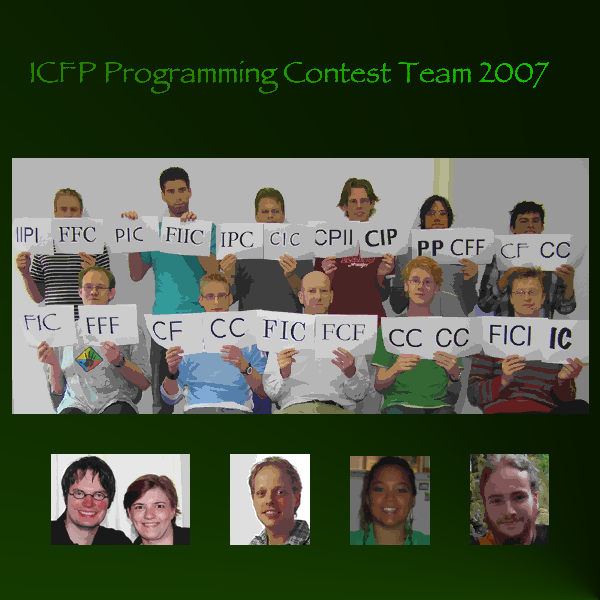
Let's start with the prefix we've been given in the photo of the organisers, (?[IFPC])![27] -> (0)ICCICIICPCCCICIICPCICIIIICP. Look for that marker and match things to the symbol table, and we find that we're setting giveMeAPresent, and the value looks like text, which turns out to be OPE. If you decided to try cracking purchase codes earlier you might recognise this as the encryption key for vmu-code, and indeed this prefix gives us that page:


There is a symbol called vmuRegCode, so maybe we need to put it in there? Unfortunately that doesn't seem to have any effect, and if we also try setting vmuMode to some obvious small values we get an error page. We'll come back to this later.

By the way, "Out of Band II" is a reference to a spaceship in "A Fire Upon The Deep", a most excellent piece of science fiction.

The steganography page mentioned yellow dots. If you look at the contest history closely, some of the letters are in yellow. And all of them are either i, c, f or p. Put them all together (chronologically) and you get another prefix, which decodes as (?[IFPFCC])F -> (0)P, and matching that pattern to the symbol table tells us that it's setting hillsEnabled to 1. Unfortunately, while the hills appear, something has gone very wrong:

If you compare this to the target image, you'll also see that the hills aren't in quite the right places. There was the clue earlier about some parabolas being swapped, but we'll need to learn more about how to read Fuun code before we can try to fix that.

What does the steganography page mean about the one image being hidden in the other? One of the simplest forms of steganography is to put information in the least significant bits. If we take each pixel, keep only the LSB of each channel, and multiply it by 255, we get this, showing the hidden image:


So let's try the same thing on all the other images we have. You can easily miss it (I did this time around, and only rediscovered it when reading our team blog again), but the left side of ET contains the number 9546. It's not immediately clear what that's good for though; if you try it as a repair guide page number it won't work, nor is it the encryption code for help-beautiful-numbers.

One of the symbols is called hitWithTheClueStick, which sounds like it should give us a clue. If you extract it, you'll notice that there are a lot of I's and C's, very few P's, and no F's. Numbers are encoded with I's and C's terminated by an P, so this looks like more data than code. The first chunk also seems to have some patterns in it. Maybe the Arecibo Message is a hint? It was a string of bits that was intended to be wrapped into a bitmap. In that case it was the product of two primes, making it easy to guess the dimensions, whereas we have 12800 bits but to the first P, but some trial and error shows that a 16×800 bitmap is readable:

Well, that's a pretty strong clue that the next chunk is going to be a PNG file. If we assume each 8 characters produces one byte (little endian), we get this:

Ok, so the next chunk is going to be an audio file. We don't know what type, but there are tools for identifying file types from content which tells us it's an MP3. And it's a voice reading out I's, C's, F's and P's. It's a bit tedious to record (it helps to use some software to slow it down), but produces the prefix (?[IFPFP])![7] -> (0)CCICCCC, which gives us this image:

Maybe some beautiful numbers are repair guide pages? 6, 28 and 496 don't do anything special, but 8128 causes my simulator to crash, so it's definitely special but we don't yet know why.

We also now have documentation on a lot of the functions. One of these is printGeneTable, where we can see a boolean argument controlling integrity checking. We've already been given some hints that various parts of the DNA are damaged, and knowing which parts might help. While we're at it, let's see if we can fix the damaged entries: since they're visible in the source, they can't be that badly damaged. We saw that each symbol name is preceded by the address and size, but what else? In between the symbols are bits of code that look like this:

IPPIICCCPPP
IPPCICCCPICIC

The general pattern seems to be "IPP", a number (which increments by 1 each time), then P or IC, and other P or IC. If we assume the last two are boolean flags, then they're probably quoted (since F is false and P is true, and those become P and IC when quoted). Match them up to the symbols, and one can deduce that these appear after the name, the first boolean indicates whether the entry is damaged or not, and the second probably indicates whether it is a function or data.

So, let's just flip the damaged flag to fix the entries! Wait a second, how do we do that without changing the size? Fortunately the number immediately before is variable-size, so if we change IC to P, we can just insert an extra bit into the number (without changing the value) to make up the space. Here's my Python code for this:

code = re.sub(
    '([CF]{23}IC[CF]{23}IC(?:[CF]{8}IC){1,}FFFFFFFFICIPP[CI]*)PIC',
    r'\1IPP', code)

Next, we push a P onto the stack (to enable the integrity checking) and call printGeneTable (followed by terminate), and:


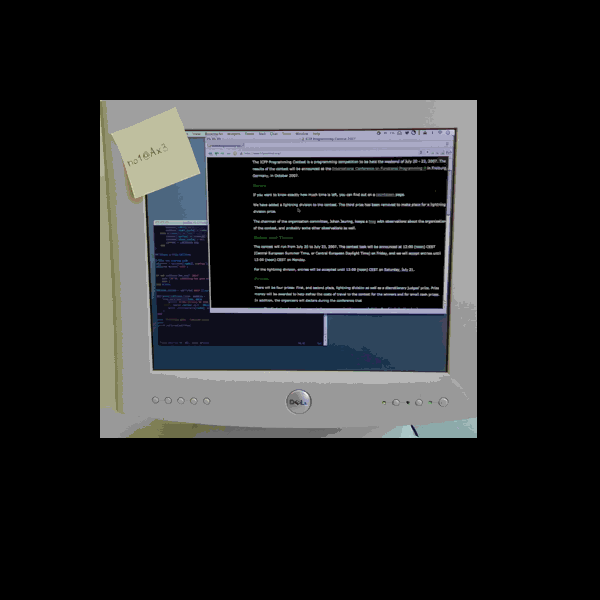
So indeed, some of the functions are damaged. A few of them were encrypted, and we've decrypted them (help-activating-genes, help-error-correcting-codes, vmu-code), but that still leaves more. We also have a few potential passwords (no1@Ax3, 9546, 8128, and Out_of_Band_II), and we now have a tool that will tell us if we've decrypted with the correct password. Some trial and error will show that 9546 decrypts cow-tail and Out_of_Band_II decrypts caravan.

What about cow-spot-middle? There is the interestingly-named cow-spot-middle-ecc symbol, of the same size, and the help page on error-correcting codes suggested we should expect 4 parity bits per 4 data bits. There is also the correctErrors function in the symbol table. You'll find that calling that first (with the right arguments) will cause cow-spot-middle to pass. When calling functions with multiple arguments, keep in mind that the first argument gets pushed to the stack first, and hence is further from the top (front) of the stack; and that integers must be encoded with 24 acids.

What about that page on palindromes? The text fades away, but you can find all the useful information in the raw text. It strongly suggests that some code might have a copy stored backwards as a backup. That would be the same size, so let's see what happens if we group symbols by size. We know cloud is one of the damaged symbols, and there is a symbol of the same size called duolc - cloud spelled backwards! And indeed, copying and reversing duolc over cloud will fix it.

How about sun? There is a function called sunflower, which is exactly the same size, and there are no sunflowers in the picture. In the case of cloud-duolc, the alteration of the name was a clue — so maybe sunflower is somehow a combination of sun and flower? Again a little trial and error is needed to consider the possibilities, but it turns out that it is their XOR (again with I=0, C=1, F=2, P=3).

Let's take a break from examining functions and try just poking some of the variables we can see. I'll assume that the functions have been fixed as appropriate. Clearly we need to turn Endo into a cow, and the VMU help page hinted that there is a Biomorphological Unit that might help. What happens if we set enableBioMorph to P (true)?


Well, he's roughly the right shape now, but he's an OCaml. But there is a variable called ocamlrules. Maybe if we change that from P (true) to F (false)?

Clearly the contest organisers had a lot of fun. Well the BMU should be adapting Endo to the local conditions, and both camels and elephants are found in dry areas — maybe if we change the weather (it's a 24-acid number)?

weather=1:

weather=2:
weather=3:

(remember to fix clouds and sun before trying these). Other values of weather don't seem to do anything.

So we can get the clouds to appear (although not in the right places or with the right sizes), together with some unwanted rain and lightning, and a bunch of things suddenly become very German. We can also get the sun to appear, in the right place, but too yellow and without the pattern in the middle. We can get Endo to turn half-way into a cow.

Notice how when weather is 1 or 2, there is also a faint shadow in the outline of the desired cow shape. Maybe the real cow is there but just almost completely transparent? We'll come back to this later.

There is a help page about Lindenmayer systems, and if you've played with them, the weeds (brown sticks on the left horizon) might look related. The impdoc page on lsystem-weeds is also a strong hint that these are L-systems with a random component. You can try calling the function yourself with different depths, but none of the options match the target. Maybe the target uses different random numbers? There is a seed variable, so you can try poking different numbers in there, and indeed the weeds will change. But what is the right value? Well the help page on L-systems refers to The Algorithmic Beauty of Plants, and we know that perfect numbers are considered beautiful, so let's try some of those. And indeed the 4th perfect number (8128) is the right value:

What about the windmill? Windmills rotate, so if anything uses polar coordinates it'll probably be that. Let's write to polarAngleIncr (it also works to call setGlobalPolarRotation). You an use trial and error to hone in on the correct angle, or you can recall that Fuuns use 256 angle steps in a circle and measure the angle adjustment you need to make (although you'll still need an experiment or two to determine the sign convention). You'll want to set it to 5:


We haven't yet used the clues about bioMul and super-adaptive genes. It looks suspiciously like functional programming, and it turns out that there is an entire functional language hidden away inside this machine! The Major Imp episodes hinted at this (Imp being short for Imperative). The terminology is a little confusing though. I'll try to explain it, but as I'm not very familiar with functional programming I'll probably make real functional programmers cry.

"Genes" are functions (the imperative functions we've seen so far are also called "genes", but they're not the same). "Adaptation Trees" are expressions. An Adaptation Tree consists of the address of a gene (function) followed by a sequence of arguments. Some of those arguments are themselves expected to be expressions; where an expression is expected, it is always represented by its length. One of the most common genes to use is activateAdaptationTree, which is followed by the address of an adaptation tree in the green zone. In this case, it first evaluates the expression in that adaptation tree (which resolves to a function, because this is a lambda calculus where everything is a function, including integers), when is then invoked with the arguments.

In the symbol table, symbols with the _adaptation suffix are adaptation trees. There are also some functional genes (like k and intBox) that don't have the suffix. We can use the information we've been given about the encoding to see what bioAdd looks like:

[ activateAdaptationTree caseVar1_adaptation
    [ activateAdaptationTree var2_adaptation ]
    [ activateAdaptationTree apply1_adaptation
        [ activateAdaptationTree bioSucc_adaptation ]
        [ activateAdaptationTree apply2_adaptation
            [ activateAdaptationTree bioAdd_adaptation ]
            [ activateAdaptationTree var1_adaptation ]
            [ activateAdaptationTree var2_adaptation ]
        ]
    ]
]

One subtlety I didn't appreciate at first is that the BioNat type isn't a function taking two arguments (although note that currying is prevalent), but a function taking a pair (which is a distinct data type). So working through this and reading the Fuun docs, we see that if var1 is 0, it returns var2, otherwise it returns the successor of something. apply2 will call var1 and var2 on the pair (getting the first and second elements), reassemble them into a pair, then pass it to bioAdd. That is actually somewhat redundant and the whole apply2 subtree could be replaced by using bioAdd directly, but no matter. This matches the description of bioAdd.

That should give us what we need to implement bioMul. Here's my implementation:

[ activateAdaptationTree caseVar1_adaptation
    [ activateAdaptationTree bioZero_adaptation ]
    [ activateAdaptationTree apply2_adaptation
        [ activateAdaptationTree bioAdd_adaptation ]
        [ activateAdaptationTree var2_adaptation ]
        [ activateAdaptationTree bioMul_adaptation ]
    ]
]

In other words, 0 * y = 0, and (x+1) * y = y + x*y. My original implementation had the last two lines swapped around, which makes no semantic difference, but the implementation of this functional language is pretty simplistic and tends to evaluate some expressions multiple times in a way that can cause a stack explosion. I spent a lot of frustrated time debugging integer overflow errors as a result.

When you patch the adaptation tree in the green zone, remember that it must be preceeded by the length and followed by the length of the rest of the green zone. Unfortunately making this change doesn't seem to have any effect. If you poke around the other adaptation trees for a while you might find biomorph_adaptation, which is a big complicated expression starting with this:

[ activateAdaptationTree enableBioMorph_adaptation
    [ activateAdaptationTree payloadBioMorph_adaptation
        [ activateAdaptationTree fromNat_adaptation
            [ activateAdaptationTree apply2_adaptation
                [ activateAdaptationTree bioMul_adaptation ]
                [ k
                    [ activateAdaptationTree mkSucc_adaptation
                        [ activateAdaptationTree mkZero_adaptation ]
                    ]
                ]
                [ k
                    [ activateAdaptationTree mkSucc_adaptation
                        [ activateAdaptationTree mkSucc_adaptation
                            [ activateAdaptationTree mkSucc_adaptation
                                [ activateAdaptationTree mkZero_adaptation ]
                            ]
                        ]
                    ]
                ]
 

So it looks like it's constructing some constants (1 and 3) and multiplying them (k take a value and returns a constant function that always returns that value), and obviously it's depending on us to fix bioMul. But there is also that enableBioMorph_adaptation adaptation right at the top. What does that do?

[ false ]

Aha! Confusingly, it has nothing to do with enableBioMorph. If we change it to [true], then the clumps of grass move into the correct positions:

Looking through the _adaptation symbols, there seem to be a few related to the goldfish. In particular, take a look at goldenFish_adaptation:

[ activateAdaptationTree mkBeforeAbove_adaptation
    [ activateAdaptationTree mkEmp_adaptation
        [ intBox 20 ]
        [ intBox 20 ]
    ]
    [ activateAdaptationTree mkBeforeAbove_adaptation
        [ activateAdaptationTree mkAbove_adaptation
            [ activateAdaptationTree mkBeforeAbove_adaptation
                [ activateAdaptationTree mkGoldfishL_adaptation ]
                [ activateAdaptationTree mkBeforeAbove_adaptation
                    [ activateAdaptationTree mkEmp_adaptation
                        [ intBox 8388606 ]
                        [ intBox 8388607 ]
                    ]
                    [ activateAdaptationTree mkGoldfishR_adaptation ]
                ]
            ]
            [ activateAdaptationTree mkBeforeAbove_adaptation
                [ activateAdaptationTree mkEmp_adaptation
                    [ intBox 45 ]
                    [ intBox 24 ]
                ]
                [ activateAdaptationTree mkGoldfishL_adaptation ]
            ]
        ]
        [ activateAdaptationTree mkBeforeAbove_adaptation
            [ activateAdaptationTree mkEmp_adaptation
                [ intBox 0 ]
                [ intBox 24 ]
            ]
            [ activateAdaptationTree mkAbove_adaptation
                [ activateAdaptationTree mkGoldfishR_adaptation ]
                [ activateAdaptationTree mkBeforeAbove_adaptation
                    [ activateAdaptationTree mkEmp_adaptation
                        [ intBox 25 ]
                        [ intBox 29 ]
                    ]
                    [ activateAdaptationTree threeFish_adaptation
                        [ activateAdaptationTree mkGoldfishR_adaptation ]
                        [ activateAdaptationTree emptyBox_adaptation ]
                    ]
                ]
            ]
        ]
    ]
]

This is describing the layout of the goldfish in some way. You don't need to understand all the details. Just try changing the various numbers to see what happens. Also try changing some of the goldfish from L to R or vice versa. You can get things mostly correct this way, but there just aren't enough goldfish. But notice that emptyBox_adaptation right at the end: what if we change it to mkGoldfishR_adaptation?

The full solution is to swap the direction of all the first, change the 0 to 18, and swap out the empty box as above. Now we have this:


That's it for the functional programming language in terms of fixing up the scene. While trying to track down bugs in my bioMul implementation I ended up learning a lot more about it, which I'll share just for interest:

  • True is a function taking two arguments and returning the first, while false takes two arguments and returns the second.
  • Zero is also a function taking two arguments and returning the first. So in fact, true, k and mkZero_adaptation have identical implementations (for whatever reason the last is an adaptation tree that simply calls an anonymous gene, which seems to be quite common).
  • Positive integers are functions that take two arguments and call the second with one less than that integer. If this sounds a lot like what caseVar1 does, it is. There is another (undocumented) adaptation called caseNat which takes a single integer (instead of a pair), and its implementation is an identity function.
  • A pair is a functor that takes a function and calls it with the elements of the pair i.e. λf.f(x)(y).
  • Apart from the "Nat" type (Peano integers), the language does allow "raw" 24-acid numbers to be used, but only where they're expected (using them in the wrong place causes them to be confused with lengths; you might have already seen this if you try to fully decompile biomorph_adaptation). intBox allows passing such a raw integer to the following expression. fromNat converts a Nat to a raw integer and passes it to the following expression. These are used to interface with imperative code via a special gene called wrapImp (which is in turn wrapped by adaptation trees like wrapSub_adaptation).

We won't get a whole lot further by just poking at variables. We'll need to start taking apart some of the code to see how it works. For example, we'll discover that there is another repair guide page that we haven't spotted yet. But that's for Part 2. If you made it this far, I hope you're having fun!

Sunday, January 26, 2020

Thoughts on Rust

I've recently spent a few days learning to program in Rust, and thought I'd write down my thoughts so far. I used programming contest problems as away to get practical experience, which probably biases things somewhat. For example, I didn't look into multi-threading, testing, or see very much of the standard library.

References

This is obviously the stand-out feature of Rust. It seems like a nice idea, and eliminating use-after-free, double-free, null pointer dereferences, and many forms of memory leak sounds great from a C/C++ perspective. While modern C++ makes it much easier to manage ownership safely, it doesn't really address borrowing.

The mutability rules also sound like a huge win for safe concurrency, but I haven't looked into any of the details.

The one thing I've found non-intuitive is that it seems sometimes references are implicitly dereferenced (e.g., you can add two references to integers) but in other places they aren't (e.g., adding in place to a mutable reference to integer).

I haven't really tried using references very heavily: my contest coding style tends not to use a lot of pointers anywhere, preferring standard library structures like vectors.

Types

I found it really annoying that there is no automatic coercion between integer types. What's worse, the typecast operator ("as") doesn't follow the same rules as arithmetic operations, namely panicking on overflow in debug builds. It's also annoying that indexing requires an unsigned type. If you have an index (of type usize) and an offset to it (of type i32, possibly negative) it is a real pain to add them to produce a new index.

The type inference also seems like spooky action at a distance: I'm all for omitting the type when declaring a variable and inferring it from the initialiser, but inferring it from usage elsewhere in the code takes some getting used to. It leads to weirdness where changing/removing some apparently unrelated line of code can cause a compilation failure, or even silently change the type of a variable. Given that the indexing requires unsigned, I worry that some variable that might need to store negative values could end up unsigned without one being aware of it just because of an inference chain from an index.

Overloading

Coming from C++, it's disappointing to have no function/method overloading, not even default arguments. It leads to having to invent names for lots of variants of basically the same function. And unfortunately I don't think it can be easily fixed, because of the aggressive type inference: overloading uses the types of arguments to select a function overload, but type inference uses the types of formal parameters to infer the types of arguments. So as soon as you add a new overload, you're reducing the power of type inference and potentially making old code no longer valid.

Traits and generics

While it took a bit of getting used to when coming from traditional OO languages like C++ and Python, I quite like the traits system. It's a lot better than Java interfaces, because you can have default implementations, and you can define new traits and bolt them on to existing classes. It's a much cleaner way to put type bounds on generics than SFINAE in C++, and seems like it probably has many of the same advantages as C++ concepts (not that I've looked at the latest incarnations of C++ concepts).

I also really like the way traits allow you to use a trait with either static dispatch (ala C++ templates) or dynamic dispatch (ala C++ virtual functions), rather than forcing the API designer to choose one or the other. I suspect there are also some performance advantages: in C++ when using a polymorphic class, you pay for a virtual function call even when the exact class is known to the programmer, unless the compiler can also determine that it is known or the programmer uses final classes/methods. With Rust there is no inheritance, so an object whose type is a concrete struct will have exactly that type.

The one thing I disliked is that methods defined in traits end up looking the same as normal methods on the class. If you're not aware that a particular method is actually provided by a trait (or you don't know which trait), it can mysteriously fail to exist if you forget to import the trait into your namespace.

The generics system still has some way to go before it catches up to C++ e.g. there are no non-type template parameters (although it's being worked on), no variadic templates, and from what I could see, no real specialisation to override more generic implementations.

Enums

I think this is one of the more under-rated features of Rust. Rust enums are really discriminated unions (ala boost::variant), with first-class language support. I particularly like the "?" operator: given an expression of type Result (which holds either an "ok" or an error), put a "?" after it, and if it is an error it will immediately return it from the function. This means that although Rust doesn't have exceptions in the same way as C++/Java/Python, one can propagate errors with very little boilerplate, and with the benefit that it's explicit where early returns might happen. It certainly looks nicer than what I've seen of Go.

Performance

I translated a few contest solutions from C++ to Rust, and was pleasantly surprised by the performance: generally faster than the C++ code (which might just be because Rust uses LLVM, which is pretty good and often better than GCC, particularly since Codeforces uses a 32-bit GCC). The one area where it was much worse is writing large outputs to stdout, because Rust always makes stdout line-buffered while GCC makes it fully-buffered when it is not a TTY (which is a known issue in Rust). After wrapping a buffer around stdout the performance was good again.

Summary

In general I like Rust, although I think it still needs a few years to mature before I'd consider abandoning C++ for it. While Go seems to be getting all the popularity, I think a high-performance language really needs to avoid garbage collection and provide a strong compile-time generics system.

Saturday, January 20, 2018

COCI 2017/2018 r5 analysis

For the problem texts, see here. I found this contest easier than usual for a COCI.

Olivander

Given two wands A < B and two boxes X > Y, there is never any point in putting A in X and B in Y; if they fit, then they also fit the other way around. So sort the boxes and wands, match them up in this order and check if it all fits.

Spirale

This is really just an implementation challenge. For each spiral, walk along it, filling in the grid where the spiral overlaps it. With more than one spiral, set each grid point to the minimum of the values induced by each spiral. Of course, it is not necessary to go to \(10^{100}\); about 10000 is enough to ensure that the grid is completely covered by the partial spiral.

Birokracija

The rule for determining which employee does the next task is a red herring. Each employee does exactly one task, and the order doesn't matter. The money earned by an employee is the sum of the distance from that employee to all underlings. The can be computed by a tree DP (computing both this sum and the size of each subtree).

Karte

Suppose there is a solution. It can be modified by a series of transformations into a canonical form.Firstly, moving a false claim below an adjacent true claim will not alter either of them; thus, we can push all the false claims to the bottom and true claims to the top. At this point, the true claims can be freely reordered amongst themselves. Similarly, if we have a false claim with small a above one with a larger a, we can swap them without making either true. So we can assume that the false claims are increasing from bottom to top in the deck. Finally, given a true claim with large a and a false claim with small a, we can swap them and they will both flip (so the positions of false claims stay the same).

After these transformations, the deck will, from bottom to top, contain the largest K cards in increasing order, followed by the rest in arbitrary order (let's say increasnig). To solve the problem, we simply construct this canonical form, then check if it indeed satisfies the conditions.

Pictionary

When building roads on the day with factor F, we don't actually need to build roads between every pair of multiples of F: it is equivalent to connect every multiple of F to F. This gives O(N log M) roads. We can represent the connected components after each day with a standard union-find structure. For reasons we'll see later, we won't use path compression, but always putting the smaller component under the larger one in the tree is sufficient to ensure a shallow tree (in theory O(log N), but I found the maximum depth was 6). A slow solution would be to check every remaining query after each day to see whether the two mathematicians are in the same component yet.

To speed this up, we can record extra information in the tree: for each edge, we record the day on which it was added. If the largest label on a path from A to B is D, then D was the first day on which they were connected (this property would be broken by path compression, which is why we cannot use it). Thus, to answer a query, we need only walk up the tree from each side to the least common ancestor; and given the shallowness of the tree, is this cheap.

Planinarenje

I really liked this problem. Take a single starting peak P. Let A be the size of the maximum matching the graph, and let B be the size of the maximum matching excluding P. Suppose A = B. Then Mirko can win as follows: take the latter matching, and whenever Slavko moves to a valley, Mirko moves to the matched peak. Slavko can never move to a valley without a match, because otherwise the journey would form an augmenting path that would give a matching for the graph of size B + 1.

Conversely, suppose A > B. Then take a whole-graph matching, which by the assumption must include a match for P. Slavko can win by always moving to the matched valley. By a similar argument, Mirko can never reach an unmatched peak, because otherwise toggling all the edges on their journey would give a maximum matching that excludes P.

To implement it, it may not be efficient enough to construct a new subgraph matching from every peak. Instead, one can start with a full-graph matching, remove P and its match from the graph (if any), then re-augment starting from that match. This should give an O(NM) algorithm (O(NM) for the initial matching, then O(M) per query).

Sunday, November 26, 2017

Analysis of Croatian Open contest 2017r3

This round of COCI was more challenging than usual, with some of the lower-scoring problems being particularly difficult.

Aron

This was quite straightforward: run through the letters, and each time a letter is different to the previous one (or is the first one), increment a counter.

Programiranje

Firstly, one word can be made by rearranging the letters of another if and only if they have the same letter frequencies. So if we have a fast way to find the letter frequencies in any substring, the problem is solved. Consider the sequence whose ith element is 1 if S[i] is 'a' and 0 otherwise: the number of a's in a substring is then just a contiguous sum of this sequence. By precomputing the prefix sum, we can find the sum of any interval in constant time. We thus just need to store 26 prefix sum tables, one for each letter.

Retro

The first part (finding the length) is a reasonably standard although fiddly dynamic programming problem. At any point in the process, one has a position relative to the original grid and a nesting depth, and need to know the longest suffix that will complete a valid bracket sequence. For each of the (up to) three possible moves, one can compute the state would be reached, and find the longest possible sequence from previously computed values.

My attempt at the second part during the contest was overly-complex and algorithmically too slow, involving trying to rank all length-L strings represented by DP states, for each L in increasing order. This required a lot of sorting, making the whole thing O(N³ log N) (where N is O(R + C)).

A simpler and faster solution I wrote after the contest is to reconstruct the path non-deterministically, one bracket at a time. Instead of working from a single source state, keep a set of candidate states (in super-position). From those, run a breadth-first (or depth-first) search to find all states where one might encounter the next bracket. Any transition that is optimal (for length) in the original DP now becomes an edge in this search. Once the candidate states for the next bracket has been found, there might be a mix of opening and closing brackets. If so, discard those states corresponding to closing brackets, since they will not be lexicographically minimal.

Portal

I didn't attempt this problem, and am not sure how to solve it. I suspect it requires coming up with and proving a number of simplifying assumptions which allow the search space to be reduced.

Dojave

I really liked this problem. First of all, M = 1 is a bit tricky, because it's the only case where you can't swap two numbers without having an effect. It's easy enough to solve by hand and treat as a special case.

Now let's count all the cases where the player can't win. Let's say that the lit elements have an XOR of K. For M > 1, we can't have \(K = 2^M - 1\), since otherwise the player could swap either two lit or two unlit numbers and win. Let \(K' = K \oplus 2^M - 1\), and consider a lit number A. To win, the player has to swap it with B such that  \(A \oplus B = K'\). As the RHS can't be 0, the lit numbers must be grouped into pairs with XOR of K'. The XOR of all the lit numbers must thus be either 0 or K', depending on whether there are an even or odd number of such pairs. But this is K (by definition); and since K = K' is impossible, we must have K = 0.

So now we need to find intervals such that the XOR of all elements is 0, and for every pair of complementary elements A and B, they are either both inside or both outside the interval. The first part is reasonably easy to handle: we can take a prefix sums (using \(\oplus\) instead of addition), and an interval with XOR of 0 is one where two prefix sums are equal. For the second part, we can use some sweeps: for each potential left endpoint, establish an upper bound on the right endpoint (considering only complementary pairs that lie on opposite sides of the left endpoint), and vice versa - doable with an ordered set or a priority queue to keep track of right elements of complementary pairs during the sweep. Now perform another left-to-right sweep, keeping track of possible left endpoints that are still "active" (upper bound not yet reached), and each time a right endpoint is encountered, query how many of the left endpoints with the same suffix sum are above the lower bound for the right end-point. Actually getting the count in logarithmic time requires a bit of fancy footwork with data structures that I won't go into (e.g. a Fenwick tree, a segment tree or a balanced binary tree with node sizes in the internal nodes).

Sažetak

I somehow miscounted and didn't realise that this problem even existed until after the contest (maybe because I don't expect more than three harder problems in COCI). It's disappointing, because it only took me about 15 minutes to solve after the contest, yet was worth the most points.

For each K-summary, draw a line between each pair of adjacent segments of that summary. For example, with a 2-summary and 3-summary and N=9, you would get |01|2|3|45|67|8|9|. Clearly in any marked interval with more than one number, none of them can be determined. It is also not hard to see that in any interval with exactly one number, that number can be determined (hint: find the sum of all numbers except that one). Thus, we need the count of numbers X such that X is a multiple of some Ki and X+1 is a multiple of another Kj. Note that if any K=1 then the answer is simply N, which we'll assume is handled as a special case.

If one has chosen a single Ki and Kj, it is not difficult to determine the numbers that satisfy the property, using the Chinese Remainder Theorem (they will be in arithmetic progression, with period Ki×Kj, and so are easy to count). However, this can easily lead to double-counting, and we thus need to apply some form of inclusion-exclusion principle. That is, we can pick any two subsets S and T of the K's, with products P and Q, and count the number of X's such that P divides X and Q divides X + 1. Note that S and T must be disjoint, as otherwise the common element would need to divide X and X+1 (and we assumed Ki > 1). We also need to determine the appropriate coefficient to scale this term in the sum. Rather than trying to derive equations, I let the computer do the work: for each value of |S| and |T| I consider every possible subset of S and of T (actually, just each possible size), add up the coefficients they're already contributing, and set the coefficient for this value of |S| and |T| to ensure that the total is 1.

Monday, June 12, 2017

Extra DCJ 2017 R2 analysis

Flagpoles

My solution during the contest was essentially the same as the official analysis. Afterwards I realised a potential slight simplification: if one starts by computing the second-order differences (i.e., the differences of the differences), then one is looking for the longest run of zeros, rather than the longest run of the same value. That removes the need to communicate the value used in the runs at the start and end of each section.

Number Bases

I missed the trick of being able to uniquely determine the base from the first point at which X[i] + Y[i] ≠ Z[i]. Instead, at every point where X[i] + Y[i] ≠ Z[i], I determine two candidate bases (depending on whether there is a carry of not). Then I collect the candidates and test each of them. If more than three candidates are found, then the test case is impossible, since there must be two disjoint candidate pairs.

Broken Memory

My approach was slightly different. Each node binary searches for its broken value, using two other nodes to help (and simultaneously helping two other nodes). Let's say we know the broken value is in a particular interval. Split that interval in half, and compute hashes for each half on the node (h1 and h2) and on two other nodes (p1 and p2, q1 and q2). If h1 equals p1 or q1, then the broken value must be in interval 2, or vice versa. If neither applies, then nodes p and q both have broken values, in the opposite interval to that of the current node. We can tell which by checking whether p1 = q1 or p2 = q2.

This does rely on not having collisions in the hash function. In the contest I relied on the contest organisers not breaking my exact choice of hash function, but it is actually possible to write a solution that works on all test data. Let P be a prime greater than \(10^{18}\). To hash an interval, compute the sums \(\sum m_i\) and \(\sum i m_i\), both mod P, giving a 128-bit hash. Suppose two sequences p and q collide, but differ in at most two positions. The sums are the same, so they must differ in exactly two positions j and k, with \(p_j - q_j = q_k - p_k\) (all mod P). But then the second sums will differ by
\(jp_j + kp_k - jq_j - kq_k = (j - k)(p_j - q_j)\), and since P is prime and each factor is less than P, this will be non-zero.

Alternative Code Jam 2017 R3 solution

This last weekend was round 3 of Code Jam 2017 and round 2 of Distributed Code Jam 2017. I'm not going to describe how to solve all the problems since there are official analyses (here and here), but just mention some alternatives. For this post I'll just talk about one problem from Code Jam; some commentary on DCJ will follow later.

Slate Modern (Code Jam)

The idea I had for this seems simpler (in my opinion, without having tried implementing both) than the official solution, but unfortunately I had a bug that I couldn't find until about 10 minutes after the contest finished.

As noted in the official analysis, one can first check whether a solution is possible by comparing each pair of fixed cells: if the difference is value is greater than D times the Manhattan distance, then it is impossible; if no such pair exists, it is possible. The best solution is then found by setting each cell to the smallest lower bound imposed by any of the fixed cells.

Let's try to reduce the complexity by a factor of C, by computing the sum of a single row quickly. If we look at the upper bound imposed by one fixed cell, it has the shape \(b + |x - c| D\), where \(x\) is the column and b, c are constants. When combining the upper bounds, we take the lowest of them. Each function will be the smallest for some contiguous (possibly empty) interval. By sweeping through the fixed cells in order of c, we can identify those that contribute, similar to finding a Pareto front. Then, by comparing adjacent functions one can find the range in which each function is smallest, and a bit of algebra gives the sum over that range.

This reduces the complexity to O(RN + N²) (the N² is to check whether a solution is possible, but also hides an O(N log N) to sort the fixed cells). That's obviously still too slow. The next insight is that most of the time, moving from one row to the next changes very little: each of the functions increases or decreases by one (depending on whether the corresponding fixed cell is above or below the row), and the range in which each function is smallest grows or shrinks slightly. It thus seems highly likely that the row sum will be a low-degree polynomial in the row number. From experimentation with the small dataset, I found that it is actually a quadratic (conceptually it shouldn't be too hard to prove, but I didn't want to get bogged down in the details).

Note that I said "most of the time". This will only be true piecewise, and we need to find the "interesting" rows where the coefficients change. It is fairly obvious that rows containing fixed cells will be interesting. Additionally, when the range in which a function is smallest disappears or appears will be interesting. Consider just two fixed cells, and colour the whole grid according to which of the two fixed cells gives the lower upper bound. The boundary between the two colours can have diagonal, horizontal and vertical portions, and it is these horizontal portions that are (potentially) interesting. I took the conservative approach of adding all O(N²) such rows as interesting.

Now that we have partitioned the rows into homogeneous intervals, we need to compute the sum over each interval efficiently. Rather than determine the quadratic coefficients analytically, I just interfered them by taking the row sums of three consecutive rows (if there are fewer than three rows in the interval, just add up their row sums directly). A bit more algebra to find the sum of a quadratic series, and we're done! There are O(N²) intervals to sum and it requires O(N) to evaluate each of the row sums needed, giving a running time of O(N³). I suspect that this could probably be reduced to O(N² log N) by being smarter about how interesting rows are picked, but it is not necessary given the constraints on N.

Tuesday, November 22, 2016

An alternative DCJ 2016 solution

During this year's Distributed Code Jam I had an idea for solving the hard part of Toothpick Sculptures, but had no time to implement it, or even to work out all the details. When the official solution was presented, I was surprised that it was very different to mine. Recently Pablo from Google has been able to help me check that my solution does indeed pass the system tests (thanks Pablo), so it seems like a good time to describe the solution.

There are going to be a lot of different trees involved, so let's give them names. A "minitree" is one of the original sculptures of N toothpicks, and its root is a "miniroot". The "maxitree" is the full tree of 1000N toothpicks. Let's assume that each minitree is built out of toothpicks of one colour. We can then consider a tree whose vertices are colours, called the "colour tree", which contains an edge between two colours if and only if the maxitree contains an edge between two vertices of those colours.

For each colour, we can find its children in the colour tree by walking the corresponding minitree looking for children which are miniroots. This can be done in parallel over the colours.

For a given vertex, we can use DP to solve the following two problems for the subtree: what is the minimum cost to stabilise the subtree if we stabilise the root, and what is the minimum cost if we do not stabilise the root? But this will not be so easy to parallelise. We can go one step further: if we fix some vertex C and cut off the subtree rooted at C, then we can answer the same two problems for each case of C being stabilised or not stabilised (four questions in total). If we later obtain the answers to the original two queries for C, then we can combine this with the four answer we have to answer the original queries for the full tree.

This is sufficient to solve the small problem, and more generally any test case where the colour tree does not branch. For each miniroot, compute the DP, where the miniroot corresponding to the single child (if any) in the colour tree is the cutoff. These DPs can be done in parallel, and the master can combine the results.

Let's consider another special case, where the colour tree is shallow. In this case, one can solve one layer at a time, bottom up, without needing to use the cutoff trick at all. The colours in each layer of the colourtree are independent and can be solved in parallel, so the latency is proportional to the depth of the tree. The results of each layer are fed into the calculations of the layer above.

So, we have a way to handle long paths, and a way to handle shallow trees. This should immediately suggest light-heavy decomposition. Let the "light-depth" of a node in the colour tree be the number of light edges between it and the root. The native of light-heavy decomposition guarantees that light-depth is at most logarithmic in the tree size (which is 1000). We will process all nodes with the same light-depth in parallel. This means that a node in a tree may be processed at the same time as its children, but only along a heavy path. We thus handle each heavy path using the same technique as in the small problem. For other children in the colour tree, the subtree results were computed in a previous pass and are sent to the slave.

TCO 2016 finals

The final round of TCO 2016 did not go well for me. I implemented an over-complicated solution to the 500 that did not work (failed about 1 in 1000 of my random cases), and I started implementing the 400 before having properly solved it, leading to panic and rushed attempts to fix things in the code rather than solving the problem.

Easy

The fact that there are only four mealtimes is a clue that this will probably require some exponential time solution. I haven't worked out the exact complexity, but it has at least a factor of \(2^\binom{n}{n/2}\) for n mealtimes.

Let's restrict our attention to meal plans that contain no meals numbered higher than m and have t meals in the plan (t can be less than 4). We can further categorise these meals by which subsets of the mealtimes can accommodate the plan. This will form the state space for dynamic programming. To propagate forwards from this state, we iterate over the number of meals of type m+1 (0 to 4 of them). For each choice, we determine which subsets of mealtimes can accommodate this new meal plan (taking every subset that can accommodate the original plan and combining it with any disjoint subset that can accommodate the new meals of type m+1).

Medium

Let's start by working out whether a particular bracket sequence can be formed. Consider splitting the sequence into a prefix and suffix at some point. If the number of ('s in the prefix differs between the initial and target sequence, then the swaps that cross the split need to be used to increase or decrease the number of ('s. How many ('s can we possibly move to the left? We can answer that greedily, by running through all the operations and applying them if and only if they swap )( to (). Similarly, we can find the least possible number of ('s in the final prefix.

If our target sequence qualifies by not having too many or too few ('s in any prefix, can we definitely obtain it? It turns out that we can, although it is not obvious why, and I did not bother to prove it during the contest. Firstly, if there is any (proper) prefix which has exactly the right number of ('s, we can split the sequence at this point, choose not to apply any operations that cross the split, and recursively figure out how to satisfy each half (note that at this point we are not worrying whether the brackets are balanced — this argument applies to any sequence of brackets).

We cannot cross between having too few and too many ('s when growing the prefix without passing through having the right number, so at the bottom of our recursion we have sequences where every proper prefix has too few ('s (or too many, but that can be handled by symmetry). We can solve this using a greedy algorithm: for each operation, apply it if and only if it swaps )( to () and the number of ('s in the prefix is currently too low. We can compare the result after each operation to the maximising algorithm that tries to maximise the number of ('s in each prefix. It is not hard to see (and prove, using induction) that for any prefix and after each operation is considered, the number of ('s in the prefix is:
  • between the original value and the target value (inclusive); and
  • the smaller of the target value and the value found in the maximising algorithm.
Thus, after all operations have been considered, we will have reached the target.

So now we know how to determine whether a specific bracket sequence can be obtained. Counting the number of possible bracket sequences is straightforward dynamic programming: for each prefix length, we count the number of prefixes
that are valid bracket sequence prefixes (no unmatched right brackets) for each possible nesting depth.

Hard

This is an exceptionally mean problem, and I very much doubt I would have solved it in the fully 85 minutes; congratulations to Makoto for solving all three!

For convenience, let H be the complement of G2 (i.e. n copies of G1). A Hamiltonian path in G2 is simply a permutation of the vertices, such that no two consecutive vertices form an edge in H. We can count them using inclusion-exclusion, which requires us to count, for each m, the number of paths that pass through any m chosen edges. Once we pick a set of m edges and assign them directions (in such a way that we have a forest of paths), we can permute all the vertices that are not tails of edges, and the remaining vertices have their positions uniquely determined.

Let's start by solving the case n=1. Since k is very small, we can expect an exponential-time solution. For every subset S of the k vertices and every number m of edges, we can count the number of ways to pick m edges with orientation.  We can start by solving this for only connected components, which means that m = |S| - 1 and the edges form a path. This is a standard exponential DP that is used in the Travelling Salesman problem, where one counts the number of paths within each subset ending at each vertex.

Now we need to generalise to m < |S| - 1. Let v be the first vertex in the set. We can consider every subset for the path containing v, and then use dynamic programming to solve for the remaining set of vertices. This is another exponential DP, with a \(O(3^n)\) term.

Now we need to generalise to n > 1. If a graph contains two parts that are not connected, then edges can be chosen independently, and so the counts for the graph are obtained by convolving the counts for the two parts. Unfortunately, a naïve implementation of this convolution would require something like O(n²k) time, which will be too slow. But wait, why are we returning the answer modulo 998244353? Where is our old friend 1000000007, and his little brother 1000000009? In fact, \(998244353 = 2^{23} \times 7 \times 17 + 1\), which strongly suggests that the Fast Fourier Transform will be involved. Indeed, we can perform an 1048576-element FFT in the field modulo 998244353, raise each element to the power of n, and then invert the FFT.

Despite the large number of steps above, the solution actually requires surprisingly little new code, as long as one has library code for the FFT and modulo arithmetic.

Monday, November 21, 2016

TCO 2016 semifinal 2 solutions

Semifinal 2 was much tougher than semifinal 1, with only one contestant correctly finishing two problems. The first two problems each needed a key insight, after which very little coding is needed (assuming one has the appropriate library code available). The hard problem was more traditional, requiring a serious of smaller steps to work towards the solution.

Easy

Consider the smallest special clique. What happens if we remove an element? Then we will still have a clique, but the AND of all the elements is non-zero. In particular, there is some bit position which is 1 in every element of the special clique except for 1.

We can turn that around: it suffices to find a bit position B, a number T which is zero on bit B, and a special clique containing T whose other elements are all 1 on bit B. We can easily make a list of candidates to put in this special clique: any element which is 1 on bit B and which is connected to T. What's more, these candidates are all connected to each other (through bit B), so taking T plus all candidates forms a clique. What's more, if we can make a special clique by using only a subset of the candidates, then the clique formed using all candidates will be special too, so the latter is the only one we need to test.

Medium

The key insight is to treat this as a flow/matching problem. Rather than thinking of filling and emptying an unlabelled tree, we can just build a labelled tree with the properties that if A's parent is B, then B < A and A appears earlier in p than B does. A few minutes thinking should convince you that any labelled tree satisfying these constraints can be used for the sorting.

We thus need to match each number to a parent (either another number or the root). We can set this up with a bipartite graph in the usual way: each number appears on the left, connected to a source (for network flow) with an edge of capacity 1. Each number also appears on the right, along with the root, all connected to the sink with N edges of capacity 1 (we'll see later why I don't say one edge of capacity N). Between the two sides, we add an edge A → B if B is a viable parent for A, again with capacity 1. Each valid assignment can be represented by a maxflow on this network (with flow N), where the edges across the middle are parent-child relationships. Note that normally using this approach to building a tree risks creating cycles, but the heap requirement on the tree makes that impossible.

That tells us which trees are viable, but we still need to incorporate the cost function. That is where the edges from the right numbers to the sink come in. A (non-root) vertex starts with a cost of 1, then adding more children increases the cost by 3, 5, 7, ... Thus, we set the costs of the edges from each number to the sink to this sequence. Similarly, the costs of the edges from the root to the sink have costs 1, 3, 5, 7, ... The min-cost max-flow will automatically ensure that the cheaper edges get used first, so the cost of the flow will match the cost of the tree (after accounting for the initial cost of 1 for each number, which can be handled separately).

Hard

This one requires a fairly solid grasp on linear algebra and vector spaces. The set with \(2^k\) elements is a vector subspace of \(\mathbb{Z}_2^N\) of dimension k, for some unknown N. It will have a basis of size k. To deal more easily with ordering, we will choose to consider a particular canonical basis. Given an arbitrary initial basis, one can use Gaussian reduction and back propagation to obtain a (unique) basis with the following property: the leading 1 bit in each basis element is a 0 bit in every other basis element. With this basis, it is not difficult to see that including any basis element in a sum will increase rather than decrease the sum. The combination of basis elements forming the ith sorted element is thus given exactly by the binary representation of i.

We can now take the information we're given an recast it is a set of linear equations. Furthermore, we can perform Gaussian elimination on these linear equations (which we actually do in code, unlike the thought experiment Gaussian elimination above). This leaves some basis elements fixed (uniquely determined by the smaller basis elements) and others free. Because of the constraints of the basis elements, we also get some more information. If basis i appears in an equation, its leading bit must correspond to a 1 bit in the value (and to the first 1 bit, if i is the leading basis in the equation). Similarly, if basis i does not appear, then it must correspond to a 0 bit in the value. This allows us to build a mask of where the leading bit for each basis element can be.

We now switch to dynamic programming to complete the count. We count the number of ways to assign the first B basis elements using the first C value bits. Clearly dp[0][C] = 1. To add new basis, we can consider the possible positions of its leading bit (within the low C bits), and then count the degrees of freedom for the remaining bits. If the basis is fixed then there is 1 degree of freedom; otherwise, there is a degree of freedom for each bit that isn't the leading bit of a previous basis, and it is easy to count these.

There are a few details that remain to do with checking whether there are an infinite number of solutions (which can only happen if the largest basis is unconstrained), and distinguishing between a true 0 and a 0 that is actually a multiple of 1000000007, but those are left as exercises for the reader.

Sunday, November 20, 2016

Topcoder Open 2016 Semifinal 1

Here are my solutions to the first semifinal of the TCO 2016 algorithm contest.

Easy

Let's start with some easy cases. If s = t, then the answer is obviously zero. Otherwise, it is at least 1. If s and t share a common factor, then the answer is 1, otherwise it is at least 2.
We can eliminate some cases by noting that some vertices are isolated. Specifically, if either s or t is 1 or is a prime greater than n/2 (and s≠t) then there is no solution.
Assuming none of the cases above apply, can the answer be exactly 2? This would mean a path s → x → t, where x must have a common factor with s and a (different) common factor with t. The smallest x can be is thus the product of the smallest prime factors of s and t. If this is at most n, then we have a solution of length 2, otherwise the answer is at least 3.
If none of the above cases applies, then answer is in fact 3. Let p be the smallest prime factor of s and q be the smallest prime factor of t. Then the path s → 2p → 2q → t works (note that 2p and 2q are at most n because we eliminated cases where s or t is a prime greater than n/2 above).

Medium

We can create a graph with the desired properties recursively. If n is 1, then we need just two vertices, source and sink, with an edge from source to sink of arbitrary weight.
If n is even, we can start with a graph with n/2 min cuts and augment it. We add a new vertex X and edges source → X and X → sink, both of weight 1. For every min cut of the original graph, X can be placed on either side of the cut to make a min cut for the new graph.
If n is odd, we can start with a graph with n - 1 min cuts and augment it. Let the cost of the min cut of the old graph be C. We create a new source, and connect it to the original source with an edge of weight C. The cost of the min cut of this new graph is again C (this can easily be seen by considering the effect on the max flow rather than the min cut). There are two ways to achieve a cut of cost C: either cut the new edge only, or make a min cut on the original graph.
We just need to check that this will not produce too many vertices. In the binary representation of n, we need a vertex per bit and a vertex per 1 bit. n can have at most 10 bits and at most 9 one bits, so we need at most 19 vertices.

Hard

I made a complete mess of this during the contest, solving the unweighted version and then trying to retrofit it to handle a weighted version. That doesn't work.

Here's how to do it, which I worked out based on some hints from tourist and coded at 3am while failing to sleep due to jetlag. Firstly, we'll make a change that makes some of the later steps a little easier: for each pair of adjacent vertices, add an edge with weight ∞. This won't violate the nesting property, and guarantees that there is always a solution. Let the length of an edge be the difference in indices of the vertices (as opposed to the cost, which is an input). Call an edge right-maximal if it's the longest edge emanating from a particular vertex, and left-maximal if it is the longest edge terminating at a particular vertex. A useful property is that an edge is always either right-maximal, left-maximal, or both. To see this, imagine an edge that is neither: it must then be nested inside longer edges terminating at each end, but these longer edges would cross, violating the given properties.

We can now make the following observations:
  1. If x → y is right-maximal and color[x] is used, then color[y] must be used too. This is because the path must pass through x, and after x cannot skip over y.
  2. If x → y is the only edge leaving x, then the edge will appear in a path if and only if color[x] is used.
  3. If x → y is right-maximal and x →  z is the next-longest edge from x, then x → y is in a path if and only if color[x] is used and color[z] is not used.
These statements all apply similarly for left-maximal edges of course. We can consider vertices 0 and n to be of colour 0 in the above, which is a color that must be picked. What is less obvious is that condition 1 (together with its mirror) is sufficient to determine whether a set of colours is admissible. Suppose we have a set of colours that satisfies condition 1, and consider the subset S of vertices whose colours come from this set. We want to be sure that every pair of consecutive vertices in S are linked by an edge. Suppose there is a pair (u, v) which are not. Consider the right-maximal edge from u: by condition 1, it must terminate at some vertex in S, which must then be to the right of v. But the left-maximal edge to v must start to the left of u, and so these two edges cross.

We can now use this information to construct a new graph, whose minimum cut will give us the cost of the shortest path. It has a vertex per colour, a source vertex corresponding to the special colour 0, and a sink vertex not corresponding to a colour. The vertices on the source side of the cut correspond to the colours that are visited. Every time colour C implies colour D, add an edge C → D of weight ∞, to prevent C being picked while D is not. If an edge falls into case 2 above, add an edge from color[x] to the sink with weight equal to the edge cost. Otherwise it falls into case 3; add an edge from color[x] to color[y] with weight equal to the edge cost. Each edge in the original graph now corresponds to an edge in this new graph, and the original edge is traversed if and only if the new edge forms part of the cut.

Monday, June 13, 2016

Code Jam and Distributed Code Jam 2016 solutions

Code Jam

Since the official analysis page still says "coming soon", I thought I'd post my solutions to both the Code Jam and Distributed Code Jam here.

Teaching Assistant

We can start by observing that when we take a new task, it might as well match the mood of the assistant: doing so will give us at least 5 points, not doing so will give us at most 5. Also, there is no point in getting to the end of the course with unsubmitted assignments: if we did, we should not have taken that assignment, instead submitting a previous assignment (a parity argument proves that there was a previous assignment). So what we're looking for is a way to pair up days of the course, obeying proper nesting, scoring 10 points if the paired days have the same mood and 5 points otherwise.

That's all we need to start on the small case, which can be done with a standard DP. For every even-length interval of the course, we compute the maximum score. We iterate to pick the day to match up to the first day of the interval, then use previous results to find the best scores for the two subintervals this generates.

That's O(N³), which is too slow for the large case. It turns out that a greedy approach works: every day, if the mood matches the top of the stack, submit, otherwise take a new assignment. The exception is that once the stack height matches the number of remaining days, one must submit every day to ensure that the stack is emptied.

I haven't quite got my head around a proof, but since it worked on the test case I had for the small input I went ahead and submitted it.

Forest university

The very weak accuracy requirement, and the attention drawn to it, is a strong hint that the answer should be found by simulation rather than analytically. Thus, we need to find a way to uniformly sample a topological walk of the forest. This is not as simple as always uniformly picking one of the available courses. Consider one tree in the forest: it can be traversed in some number of ways (all of them starting with the root of the tree), and the rest of the forest can be traversed in some number of ways, and then these can be interleaved arbitrarily. If we consider all ways to interleave A items and B items, then A/(A+B) of them will start with an element of A. Thus, the probability that the root of a particular tree will be chosen is proportional to the size of that tree.

After picking the first element, the available courses again form a forest, and one can continue. After uniformly sampling a sequence of courses, simply check which of the cool words appear on the hat.

Rebel against the empire

I consider this problem to be quite a bit harder than D. It's easier to see what to do, but reams of tricky code.

For the small case, time is not an issue because the asteroids are static. Thus, one just needs to find the bottleneck distance to connect asteroids 0 and 1. I did this by adding edges from shortest to longest to a union-find structure until 0 and 1 were connected (ala Kruskal's algorithm), but it can also be done by priority-first search (Prim's algorithm) or by binary searching for the answer and then checking connectivity.

For the large case we'll take that last approach, binary searching over the answers and then checking whether it is possible. Naturally, we will need to know at which times it's possible to make jumps between each pair of asteroids. This is a bit of geometry/algebra, which gives a window of time for each pair (possibly empty, possibly infinite). Now consider a particular asteroid A. In any contiguous period of time during which at least one window is open, it's possible to remain on A, regardless of S, by simply jumping away and immediately back any time security are about to catch up. Also, if two of these intervals are separated in time by at most S, they can be treated as one interval, because one can sit tight on A during the gap between windows. On the other hand, any period longer than S with no open windows is of no use.

The key is to ask for the earliest time at which one can arrive at each interval. This can be done with a minor modification of Dijkstra's algorithm. The modification is that the outgoing edges from an interval are only those windows which have not already closed by the time of arrival at the interval.

Go++

I liked this problem, and I really wish the large had been worth fewer points, because I might then have taken it on and solved it.

The key is to realise that the good strings don't really matter. Apart from the trivial case of the bad string also being a good string, it is always possible to solve the problem by producing a pair of programs that can produce every string apart from the bad one.

For the small case, we can use 0?0?0?0? (N repetitions) for the first program, and 111 (N-1 repetitions) for the second (but be careful of the special case N=1!) Each of the 1's can be interleaved once into the first program to produce a 1 in the output, but because there are only N-1 1's, it is impossible to produce the bad string.

For the large case, the same idea works, but we need something a bit more cunning. The first program is basically the same: alternating digits and ?'s, with the digits forming the complement of the bad string. To allow all strings but the bad string to be output, we want the second program to be a string which does not contain the bad string as a subsequence, but which contains every subsequence of the bad string as a subsequence. This can be achieved by replacing every 1 in the bad string by 01 and every 0 by 10, concatenating them all together, then dropping the last character. Proving that this works is left as an exercise for the reader.

Distributed Code Jam

Again

The code appears to be summing up every product of an element in A with an element in B. However, closer examination shows that those where the sum of the indices is a multiple of M (being the number of nodes) are omitted. However, once we pick an index modulo M for each, we're either adding all or none. The sum of all products of pairs is the same as the product of the sums. So, for each remainder modulo M, we can add up all elements of A, and all elements of B. Then, for each pair of remainders, we either multiply these sums together and accumulate into the grand total, or not. There are some details regarding the modulo 1000000007, but they're not difficult.

For the large case, we obviously need to distribute this, which can be done by computing each sum on a different node, then sending all the sums back to the master.

lisp_plus_plus

Here, a valid lisp program is just a standard bracket sequence (although it is required to be non-empty). It's well-known that a sequence is valid if and only if:
  • the nesting level (number of left brackets minus number of right brackets) of every prefix is non-negative; and
  • the nesting level of the whole sequence is zero.
If the nesting level ever goes negative in a left-to-right scan, then the point just before it went negative is the longest sequence that can be completed. This makes the small case trivial to implement.

To distribute this, we can do the usual thing of assigning each node an interval to work on. We can use a parallel prefix sum to find the nesting level at every point (there is lots of information on the internet about how to do this). Then, each node can find it's first negative nesting level, and send this back to a master to find the globally first one. We also need to know the total nesting level by sending the sum for each interval to the master, but that's already done as part of the parallel prefix sum.

Asteroids

I liked this one better than the Code Jam asteroids problem, but it was also rather fiddly. The small case is a straightforward serial DP: going from bottom to top, compute the maximum sum possible when ending one's turn on each location.

At first I thought that this could be parallelised in the same manner as Rocks or Mutex from last year's problems. However, those had only bottom-up and left-to-right propagation of DP state. In this problem, we have bottom-up, left-to-right and right-to-left. On the other hand, the left-to-right and right-to-left propagation is slow: at one most unit for every unit upwards. We can use this!

Each node will be responsible for a range of columns. However, let's say it starts with knowledge of the prior state for B extra columns on either side. Then after one row of DP iteration, it will correctly know the state for B-1 extra columns, and after B iterations it will still have the correct information for the columns its responsible for. At this stage it needs to exchange information with its neighbours: it will receive information about the B edge columns on either side, allowing it to continue on its way for another B rows.

There are a few issues involved in picking B. If it's too small (less than 60), then nodes will need to send more than 1000 messages. If it's too large, then nodes will do an excessive number of extra GetPosition queries. Also, B must not be larger than the number of columns a node is handling; in narrow cases we actually need to reduce the number of nodes being used.

Gas stations

The serial version of this problem is a known problem, so I'll just recap a standard solution quickly. At each km, you need to decide how much petrol to add. If there is a town within T km that is cheaper, you should add just enough petrol to reach it (the first one if there are multiple), since any extra you could have waited until you got there. Otherwise, you should fill up completely. A sweep algorithm can give the next cheaper town for every town in linear time.

What about the large case? The constraint is interesting: if we had enough memory, and if GetGasPrice was faster, there is enough time to do it serially! In fact, we can do it serially, just passing the baton from one node to the next as the car travels between the intervals assigned to each node.

What about computing the next cheaper station after each station? That would be difficult, but we don't actually need it. We only need to know whether there is a cheaper one within T km. We can start by checking the current node, using a node-local version of the next-cheapest array we had before. If that tells us that there is nothing within the current node, and T km away is beyond the end of the current node, then we will just find the cheapest within T km and check if that is cheaper than the current value. The range will completely overlap some nodes; for those nodes, we can use a precomputed array of the cheapest for each node. There will then be some prefix of another node. We'll just call GetGasPrice to fetch values on this node. Each iteration this prefix will grow by one, so we only need one call to GetGasPrice per iteration (plus an initial prefix). This means we're calling GetGasPrice at most three times per station (on average), which turns out to the fast enough. It's possible to reduce it to 2 by computing the minimum of the initial prefix on the node that already has the data, then sending it to the node that needs it.

There is one catch, which caused me to make a late resubmission. I was calling GetGasPrice to grow the prefix in the serial part of the code! You need to make all the calls up front in the parallel part of the code and cache the results.

Sunday, March 06, 2016

Solutions to Facebook Hacker Cup 2016

Since the official solutions aren't out yet, here are my solutions. Although I scored 0 in the contest, four of my solutions were basically correct, one I was able to solve fairly easily after another contestant pointed out that my approach was wrong, and I figured out Grundy Graphs on the way home.

Snake and Ladder

I'll describe two solutions to this. There are a few things one can start off with. Firstly, if there are rows at the top or bottom that are completely full of flowers, just cut them off — they make no difference. Then, handle N=1 specially: if K=1, the answer is 1, if K=0, it is 2. A number of people (including all the contest organisers!) messed up the first, and I messed up the second. Also, if one rung has two flowers on it, the answer is 0.

My contest solution used dynamic programming. If one cuts the ladder half-way between two rungs and considers the state of the bottom half, it can be divided into four cases:
  1. Only the left-hand side has the snake on it.
  2. Only the right-hand side has the snake on it.
  3. Both sides have the snake on it, and the two are connected somewhere below.
  4. Both sides have the snake on it, and the two do not connect.
It is reasonably straightforward (as long as one is careful) to determine the dynamic programming transitions to add a rung, for each possibility of a flower on the left, on the right, or no flower. Advancing one rung at a time will be too slow for the bound on N, but the transitions can be expressed as 4×4 matrices and large gaps between flowers can be crossed with fast matrix exponentiation. Finally, one must double the answer to account for the choice of which end is the head.

The alternative solution is to argue on a case-by-case basis. If there no flowers, then one can pick a row for the head and a row for the tail, and pick a column for the head (the column for the tail is then forced by parity). Once these choices are made, there is only one way to complete the snake. Also, the head and tail can only occupy the same row if it is the top or bottom row, giving 2N(N-1)+4 ways.

If there is at least one flower, then the head must be above the top flower and the tail below the bottom flower (or vice versa). Again, one can choose a row for each, with the column being forced by parity. One must also consider special cases for a flower in the top/bottom row.

Boomerang Crew

I think this was possibly the easiest of the problems, provided you thought clearly about it (which I failed to do). Clearly any opponents weaker than (or equal to) your champion can be defeated just be putting them up against your champion. Also, if you're going to defeat P players, they might as well be the weakest P players of the opposition. For a given P, can this be done? There will be a certain number of strong players (stronger than our champion), which we will have to sacrifice our weaker players against to wear them down. What's more, once we've worn one down and beaten him/her, we have to use the winner of that game to wear down the next strong opponent. Thus, we should match up the S strong players against our best S players in some order, and use our remaining players as sacrifices. Ideally we'd like to wear down each opponent to exactly the skill level of the player we will use to win; anything more is wasted effort. We can apply this idea greedily: for each opponent, find the remaining strong player of ours who can win by the smallest margin.

With that method to test a particular P, it is a standard binary search to determine the number of players we can beat.

Grundy Graph

I think this was the hardest problem: my submission wasn't a real solution and was just for a laugh; several other people I spoke to had submitted but didn't believe in their solution. During the contest I suspected that the solution would be related to 2-SAT, but it wasn't until the flight home that I could figure out how to incorporate turn ordering.

Let us construct an auxiliary directed graph A whose vertices correspond to those of the original. An edge u->v in A means that if u is black, then v must be black as well for Alice to win. All the edges in the original graph are clearly present in A. However, for each u->v in the original, we also add v'->u', where x' is the vertex assigned a colour at the same time as x. This is because if v' is black but u' is white, then it implies that u is black and v is white. This is the same as the contrapositive edge in a 2-SAT graph. Let x=>y indicate that y is reachable from x in A.

There are a number of situations in which we can see that Bob can win:
  • If any strongly connected component contains both x and x', then Bob wins regardless of what Alice and Bob play.
  • If Bob controls vertices x and y and x=>y, then Bob wins by assigning x black and y white, regardless of Alice's play.
  • If Bob controls x, Alice controls y, x=>y, x' => y', and y is played before x, then Bob wins by assigning y the opposite colour to x.
We claim that if none of the above apply, then Alice wins. Her strategy is that on her turn, she must colour x black if there is any u such that u => x and either u has already been coloured black, u could later be coloured black by Bob, or u = x'. This ensures that it does not immediately allow Bob to win, nor allows Bob to use it to win later. The only way this could fail is if both x and x' are forced to be black (if neither is forced, Alice can pick freely).

Suppose u => x and v => x', where u and v are as described above. Then x => v', so u => v'. Firstly consider u = x'. We cannot have v = x (because otherwise x, x' are in the same SCC). Now x' => v', so v => v'. If Bob controls v, then we hit the second case above; if Alice controls v, then v => v' means she would never have chosen v. So we have a contradiction. Now, if u ≠ x' (and by symmetry, v ≠ x), then consider u => v' again. Alice cannot control v/v', since she would then have chosen v' rather than v. But similarly, v => u', so Alice couldn't have chosen u. It follows that Bob controls u and v, which can only be possible if u = v'. But u and u' can only both be relevant if Bob hasn't decided their colour yet, which is the third case above.

The implementation details are largely left as an exercise. Hint: construct the SCCs of A, and the corresponding DAG of the SCCs, then walk it in topological order to check the conditions. The whole thing takes linear time.

RNG

The concept here is a reasonably straightforward exponential DP, but needs a careful implementation to get all the formulae right, particularly in the face of potential numeric instability. The graph itself isn't particularly relevant; the only "interesting" vertices are the start and the gifts, and the only useful information is the distance from each interesting vertex to each other one (if reachable) and the distance from each gift to the nearest dead-end. The DP state is the set of gifts collected and the current position (one of the interesting vertices). When one is at a gift, there are two possible options:
  1. Pick another gift, and make towards it along the shortest path. Based on the path length L, there is a probability P^L of reaching it in time DL, and a probability 1 - P^L of respawning, with an expected time computable from a formula.
  2. Aim to respawn by heading for the nearest dead-end. Again, one can work out a formula for the expected time to respawn.
When one is at the start, one should of course pick a gift and head for it. Again, one can compute an expected time to reach it (one obtains a formula that includes its own result, but a little algebra sorts that out).

Maximinimax flow

I think I liked this problem the best, even though I screwed up the limits on the binary search. Firstly, what is the minimax flow? For a general graph it would be nasty to compute, but this graph has the same number of edges as vertices. This means that it has exactly one cycle with trees hanging off of it. It shouldn't be too hard to convince yourself that the minimax flow is the smaller of the smallest edge outside the cycle and the sum of the two smallest edges inside the cycle.

Veterans will immediately reach for a binary search, testing whether it is possible to raise the minimax flow to a given level. For the edges outside the ring, this is a somewhat standard problem that can be solved with query structures e.g. Fenwick trees, indexed by edge value. To raise the minimum to a given level, one needs to know the number of edges below that level (one Fenwick tree, storing a 1 for each edge), and their current sum (a second tree, storing the edge weight for each edge).

For the vertices inside the cycle it is only slightly more complex. If the required level is less than double the second-smallest edge, then one need only augment the smallest edge. Otherwise one raises all edges to half the target, with a bit of special-casing when the target is odd. The Fenwick tree can also be queried to find the two smallest edges, but I just added a std::multiset to look this up.

Rainbow strings

This seemed to be one of the most-solved problems, and is possibly the easiest if you have a suffix tree/array routine in your toolbox. A right-to-left sweep will yield the shortest and longest possible substring for each starting position (next green for the shortest, next red for the longest). The trick is to process queries in order of length. Each entry in the suffix array will become usable at some length, and unusable again at another length, and these events, along with the queries, can be sorted by length for processing. The only remaining work is to determine the Kth of the active suffixes, which can be done with a Fenwick tree or other query structure.

Finally, one needs the frequency table for each prefix to be able to quickly count the frequency in each substring.

Wednesday, May 20, 2015

Analysis of ICPC 2015 world finals problems

Analysis of ICPC 2015 world finals problems

I haven't solved all the problems yet, but here are solutions to those I have solved (I've spent quite a bit more than 5 hours on it though).

A: Amalgamated Artichokes

This is a trivial problem that basically everybody solved - I won't go into it.

B: Asteroids

This looks quite nasty, but it can actually be solved by assembling a number of fairly standard computational geometry tools, and the example input was very helpful. To simplify things, let's switch to the frame of reference of the first asteroid, and assume only the second asteroid moves (call them P and Q for short). The first thing to notice is that the area is a piecewise quadratic function of time, with changes when a vertex of one polygon crosses an edge of the other. This is because the derivative of area depends on the sections of boundary of Q inside P, and those vary linearly in those intervals. Finding the boundaries between intervals is a standard line-line intersection problem. To distinguish between zero and "never", touching is considered to be an intersection too.
We also need a way to compute the area of the intersection. Clipping a convex polygon to a half-space is a standard problem too - vertices are classified as inside or outside, and edges that go from inside to outside or vice versa introduce a new interpolated vertex, so repeated clipping will give the intersection of convex polygons. And finding the area of a polygon is also very standard.
Finally, we need to handle the case where the best area occurs midway through one of the quadratic pieces. Rather than try to figure out the quadratic coefficients geometrically, I just sampled it at three points (start, middle, end) and solved for the coefficients, and hence the maximum, with algebra.

C: Catering

I'm sure I'm seen something similar, but I'm not sure where. It can be set up as a min-cost max-flow problem. Split every site into two, an arrival area and a departure area. Connect the source to each departure area, with cap 1 for clients and cap K for the company. Connect each arrival area to the sink similarly. Connect every departure area to every later arrival area with cap 1, except for the company->company link with cap K. Edge costs match the table of costs where appropriate, zero elsewhere. The maximum flow is now K+N (K teams leave the company, and equipment arrives at and leaves every client), and the minimum cost is the cost of the operation.

D: Cutting cheese

This is basically just a binary search for each cut position, plus some mathematics to give the volume of a sphere that has been cut by a plane.

E: Parallel evolution

Start by sorting the strings by length. A simplistic view is that we need to go through these strings in order, assigning each to one path or the other. This can be done with fairly standard dynamic programming, but it will be far too slow.
Add an "edge" from each string to the following one if it is a subsequence of this following one. This will break the strings up into connected chains. A key observation is that when assigning the strings in a chain, it is never necessary to switch sides more than once: if two elements in a chain are on one path, one can always put all the intervening elements on the same path without invalidating a solution. Thus, one need only consider two cases for a chain: put all elements in one path (the opposite path to the last element of the previous chain), or start the chain on one path then switch to the other path part-way through. In the latter case, one should make the switch as early as possible (given previous chains), to make it easier to place subsequent strings. A useful feature is that in either case, we know the last element in both paths, which is all that matters for placing future chains. Dynamic programming takes care of deciding which option to use. Only a linear number of subsequence queries is required.
I really liked this problem, even though the implementation in messy. It depends only on the compatibility relationship being a partial order and there being a cheap way to find a topological sort.

F: Keyboarding

This can be done with a fairly standard BFS. The graph has a state for each cursor position and number of completed letters. There are up to 5 edges from each state, corresponding to the 5 buttons. I precomputed where each arrow key moves to from each grid position, but I don't know if that is needed. It's also irrelevant that keys form connected regions.

H: Qanat

This is a good one for a mathsy person to work out on paper while someone else is coding - the code itself is trivial. Firstly, the slope being less than one implies that dirt from the channel always goes out one of the two nearest shafts - whichever gets it to the surface quicker (it helps to think of there being a zero-height shaft at x=0). Between each pair of shafts, one can easily find the crossover point.
Consider just three consecutive shafts, and the cost to excavate them and the section of channel between them. If the outer shafts are fixed, the cost is a quadratic in the position of the middle shaft, from which one can derive a formula for its position in terms of its neighbours. This gives a relationship of the form xi+2 - gxi+1 + xi = 0. In theory, this can now be used to iteratively find the positions of all the shafts, up to a scale factor which is solved by the requirement for the final shaft (the mother well) to be at x=W.
I haven't tested it, but I think evaluating the recurrence could lead to catastrophic rounding problems, because errors introduced early on are exponentially scaled up, faster than the sequence itself grows. The alternative I used is to find a closed formula for the recurrence. This is a known result: let a and b be the roots of x2 - gx + 1 = 0; then the ith term is r(ai - bi) for the scale factor r. Finding the formula for g shows that the roots will always be real (and distinct) rather than complex.

I: Ship traffic

This mostly needed some careful implementation. For each ship, there is an interval during which the ferry cannot launch. Sort the start and end times of all these intervals and sweeping through them, keeping track of how many ships will be hit for each interval between events. The longest such interval with zero collisions is the answer.

J: Tile cutting

Firstly, which sizes can be cut, and in how many ways? If the lengths from the corners of the parallelograms to the corners of the tile are a, b, c, d, then the area is ab + cd. So the number of ways to make a size is the number of ways it can be written as ab + cd, for a, b, c, d > 0. The number of ways to write a number as ab can be computed by brute force (iterate over all values of a and b for which ab <= 500000). The number of ways to write a number as ab + cd is the convolution of this function with itself (ala polynomial multiplication). There are well-known algorithms to do this in O(N log N) time (with an FFT) or in O(N1.58) time (divide-and-conquer), and either is fast enough.

K: Tours

I've got a solution that passes, but I don't think I can fully prove why.
I start by running a DFS to decompose the graph into a forest plus edges from a node to an ancestor in the forest. Each such "up" edge corresponds to a simple cycle. Clearly, the number of companies must divide into the length of any cycle, so we can take the GCD of these cycle lengths.
If the cycles were all disjoint, this would (I think) be sufficient, but overlapping cycles are a problem. Suppose two cycles overlap. That means there are two points A and B, with three independent paths between them, say X, Y, Z. If X has more than its share of routes from some company, then Y must have less than its share, to balance the tour X-Y. Similarly, Z must have less than its share. But then the tour Y-Z has too few routes from that company. It follows that X, Y and Z must all have equal numbers of routes from each company, and hence the number of companies must divide into each of their lengths.
And now for the bit I can't prove: it seems to be sufficient to consider only pairs of the simple cycles corresponding to using a single up edge. I just iterate over all pairs and compute the overlap. That is itself not completely trivial, requiring an acceleration structure to compute kth ancestors and least common ancestors.

L: Weather report

This is an interesting variation of a classic result in compression theory, Hamming codes. The standard way to construct an optimal prefix-free code from a frequency table is to keep a priority queue of coding trees, and repeatedly combine the two least frequent items by giving them a common parent. That can't be done directly here because there are trillions of possible strings to code, but it can be done indirectly by noting that permutations have identical frequency, and storing them as a group rather than individual items. The actions of the original algorithm then need to be simulated, pairing up large numbers of identical items in a single operation.

Sunday, October 26, 2014

2014 NEERC Southern Subregional

The ICPC NEERC South Subregional was mirrored on Codeforces. It was a very nice contest, with some approachable but also challenging problems. Here are my thoughts on the solutions (I solved everything except A, J and L during the contest).

A: Nasta Rabbara

This is quite a nasty one, and my initial attempt during the contest was all wrong. The first thing to be aware of is that a single query can be answered in O(L log L) time (or less) using a modification on the standard union-find data structure: each edge in the union-find structure is labelled to indicate whether end-points have the same or the opposite parity, and the find operation tracks whether the returned root has the same or opposite parity as the query point. That way, edges that create cycles can be found to be either odd- or even-length cycles. Of course, this won't be fast enough if all the queries are large.

Ideally, one would like a data structure that allows both new edges to be added and existing edges to be removed. That would allow for a sliding-window approach, in which we identify the maximal left end-point for each right end-point. However, the 10 second time limit suggests that this is not the right approach.

Instead, there is a \(O(N+(M+Q)\sqrt{M}\log N)\) solution. Dividing the series into blocks of length \(\sqrt{M}\). For each block, identify all the queries with a right end-point inside the block. Now build up a union-find structure going right-to-left, starting from the left edge of the block. Whenever you hit the left end-point of one of the identified queries, add the remaining episodes for the query (which will all come from inside the block) to answer the query, then undo the effect of these extra episodes before continuing. As long as you don't do path compression, each union operation can be unwound in O(1) time. This will miss queries that occur entirely inside a block, but these can be answered by the algorithm from the first paragraph as they are short.

B: Colored blankets

It turns out that it is always possible to find a solution. Firstly, blankets with no colour can be given an arbitrary colour on one side. It is fairly easy to see that we need only allocate blankets to kits such that each kit contains blankets of at most two colours. Repeat the following until completion:
  1. If any colour has at most K/N blankets remaining and that colour has not been painted onto any kit, put those blankets into a new kit and paint it with that colour (this might involve zero blankets into that kit).
  2. Otherwise, pick any colour that has not been painted on a kit. There must be a more than K/N blankets of that colour. Use enough of them to fill up any non-full painted kit. There must be such a kit, otherwise there are more than K blankets in total.
Since each kit is painted with a unique colour, this generates at most N kits; and since each kit has K/N blankets in it, it must generate exactly N kits.

C: Component tree

The only difficulty with this problem is that the tree might be very deep, causing the naive algorithm to spend a lot of time walking up the tree. This can be solved with a heavy-light decomposition. On each heavy path, for each attribute that appears anywhere on the path, store a sorted list (by depth) of the nodes containing that attribute. When arriving on a heavy path during a walk, a binary search can tell where the nearest ancestor with that property occurs on the heavy path. I think this makes each query O(log N) time.

D: Data center

This is a reasonably straightforward sliding window problem. Sort the servers of each type, and start with the minimum number of low voltage servers (obviously taking biggest first). One might also be required to take all the low voltage servers plus some high voltage servers. Then remove the low voltage servers one at a time (smallest first), and after each removal, add high voltage servers (largest first) until the capacity is made up. Then compare this combination to the best solution so far.

E: Election

Firstly, ties can be treated as losses (both within a station and in the election), because we want the mayor to win. When merging two stations, there are two useful results that can occur: win+loss -> win, or loss+loss -> loss; in both cases the number of wins stays the same, while the number of losses goes down by one. So they are equally useful. We can determine the number of viable merges by DP: either the last two can be merged, and we solve for the other N-2; or the last one is untouched, and we solve for the other N-1.

F: Ilya Muromets

Note that the gap closing up after a cut is just a distraction: any set of heads we can cut, can also be cut as two independent cuts of the original set of heads.

We can determine the best cut for every prefixes in linear time, by keeping a sliding window of sums (or using a prefix sum). Similarly, we can determine the best cut for every suffix. Any pair of cuts can be separated into a cut of a prefix and of the corresponding suffix, so we need only consider each split point in turn.

G: FacePalm

Let's consider each k contiguous days in turn, going left to right. If the current sum is non-negative, we need to reduce some of the values. We might as well reduce the right-most value we can, since that will have the effect on as many future values as possible (past values have already been fixed to be negative, so that is not worth considering). So we reduce the last value as much as needed, or until it reaches the lower limit. If necessary, we then reduce the second-last value, and so on until the sum is negative.

The only catch is that we need a way to quickly skip over long sequences of the minimum value, to avoid quadratic running time. I kept a cache of previous non-minimum value (similar to path compression in union-find structures); a stack of the positions of non-minimum values should work too.

H: Minimal Agapov code

The first triangle will clearly consist of the minimum three labels. This divides the polygon into (up to) three sections. Within each section, the next triangle will always stand on the existing diagonal, with the third vertex being the lowest label in the section. This will recursively subdivide the polygon into two more sections with one diagonal, and so on. One catch is that ties need to be broken carefully: pick the one furthest from the base with the smaller label (this lead to me getting a WA). Rather than considering all the tie-breaking cases for the first triangle, I started with a first diagonal with the two smallest labels, and found the first triangle through the recursion.

The main tool needed for this is an efficient range minimum query. There are a number of data structures for this, and any of them should work. I used two RMQ structures to cater for the two possible tie-breaking directions. The cyclic rather than linear nature of the queries, but it is just a matter of being careful.

I: Sale in GameStore

This was the trivial problem: sort, get your friends to buy the most expensive item, start filling up on cheap items until you can't buy any more or you've bought everything.

J: Getting Ready for the VIPC

I got a wrong answer to test case 53 on this, and I still don't know why. But I think my idea is sound.

The basic approach is dynamic programming, where one computes the minimum tiredness one can have after completing each contest, assuming it is possible to complete it (this also determines the resulting skill). To avoid some corner cases, I banned entering a contest with tiredness greater than \(h_i - l_i\). However, this is \(O(N^2)\), because for each contest, one must consider all possible previous contests.

The first optimisation one can do is that one can make a list of outcomes for each day, assuming one enters a contest that day: a list of (result skill, tiredness), one for each contest. If one contest results in both less skill and more tiredness than another, it can be pruned, so that one ends up with a list that increases in both skill and tiredness. Now one can compute the DP for a contest by considering only each previous day, and finding the minimum element in the list for which the skill in great enough to enter the current contest. The search can be done by binary search, so if there are few distinct days with lots of contests each day, this will be efficient; but if every contest is on a different day, we're no better off.

The second optimisation is to note the interesting decay function for tiredness. After about 20 days of inactivity, tireness is guaranteed to reach 0. Thus, there is no need to look more than this distance into the past: beyond 20 days, we only care about the maximum skill that can be reached on that day, regardless of how tired one is. This reduces the cost to \(O(N\log N\log maxT\). 

K: Treeland

Pick any vertex and take its nearest neighbour: this is guaranteed to be an edge; call the end-points A and B. An edge in a tree partitions the rest of the tree into two parts. For any vertex C, either d(A, C) < d(B, C) or vice versa, and this tells us which partition C belongs to. We can thus compute the partition, and then recursively solve the problem within each partition.

L: Useful roads

I didn't solve this during the contest, and I don't know exactly how to solve it yet.

M: Variable shadowing

This is another reasonably straightforward implementation problem. For each variable I keep a stack of declarations, with each declaration tagged with the source position and a "scope id" (each new left brace creates a new scope id). I also keep a stack of open scope ids. When a right brace arrives, I check the top-of-stack for each variable to see if it matches the just closed scope id, and if so, pop the stack.